Choosing a Pipe Fittings Supplier UAE Dubai projects can trust is an engineering decision, not a price comparison. A wrong elbow radius, an unverified heat number or a mismatched schedule can stall a hydrotest and delay a shutdown. This guide gives piping engineers, MEP contractors and procurement heads a working framework for specifying and sourcing fittings across the GCC.
The sequence follows how a line is designed: fluid behaviour, fitting classification, materials, pressure ratings, Gulf compliance and local supply. You also get three working tools: an RFQ line template, a service-to-grade selector and a five-point verification matrix.
Table of Contents
- How Do Fittings Change Fluid Behaviour in Industrial Piping?
- Which Fitting Types Do Industrial Pipelines Use?
- How Do You Select Carbon, Stainless or Duplex Steel for GCC Service?
- What Do SCH 40, 80, 160 and XXS Mean for Pressure Safety?
- What Compliance Checks Should a Pipe Fittings Supplier UAE Dubai Meet Before Shipping?
- Why Choose a Direct-Stocking Pipe Fittings Supplier UAE Dubai Teams Rely On?
- Final Recommendations for Choosing a Pipe Fittings Supplier UAE Dubai
- Frequently Asked Questions About Pipe Fittings in the UAE
How Do Fittings Change Fluid Behaviour in Industrial Piping?
Every fitting changes flow direction, velocity or cross-section, so each one adds pressure drop and turbulence to the line. Long radius elbows, concentric reducers and straight tees each impose a different loss coefficient, which is why fitting geometry affects pump sizing, erosion and noise.
A long radius elbow bends at 1.5 times nominal pipe size, while a short radius elbow bends at 1.0 times. The gentler bend cuts turbulence and erosion, so long radius is the default for process, slurry and high-velocity steam lines. Short radius is reserved for tight skids and congested racks.
Reducers deserve equal attention. Use eccentric reducers flat side up on pump suction lines to avoid air pockets and cavitation, and flat side down on rack runs to hold a constant bottom-of-pipe elevation. Concentric reducers suit vertical runs and gas lines where symmetry matters.
A reliable supplier will ask for these details before quoting. Three flow checks belong on every isometric:
- Elbows: specify long radius unless the layout justifies short radius.
- Tees: use a reducing tee instead of an equal tee plus a reducer to remove one weld.
- Reducers: state flat on top (FOT) or flat on bottom (FOB) on the drawing.
Which Fitting Types Do Industrial Pipelines Use?
Industrial pipelines use three fitting families: butt-weld fittings per ASME B16.9 for large-bore runs, forged threaded or socket-weld fittings per ASME B16.11 for small-bore lines, and flanges per ASME B16.5 for removable joints. Each family suits a defined size range, pressure class and maintenance pattern.
What Are ASME B16.9 Butt-Weld Fittings?
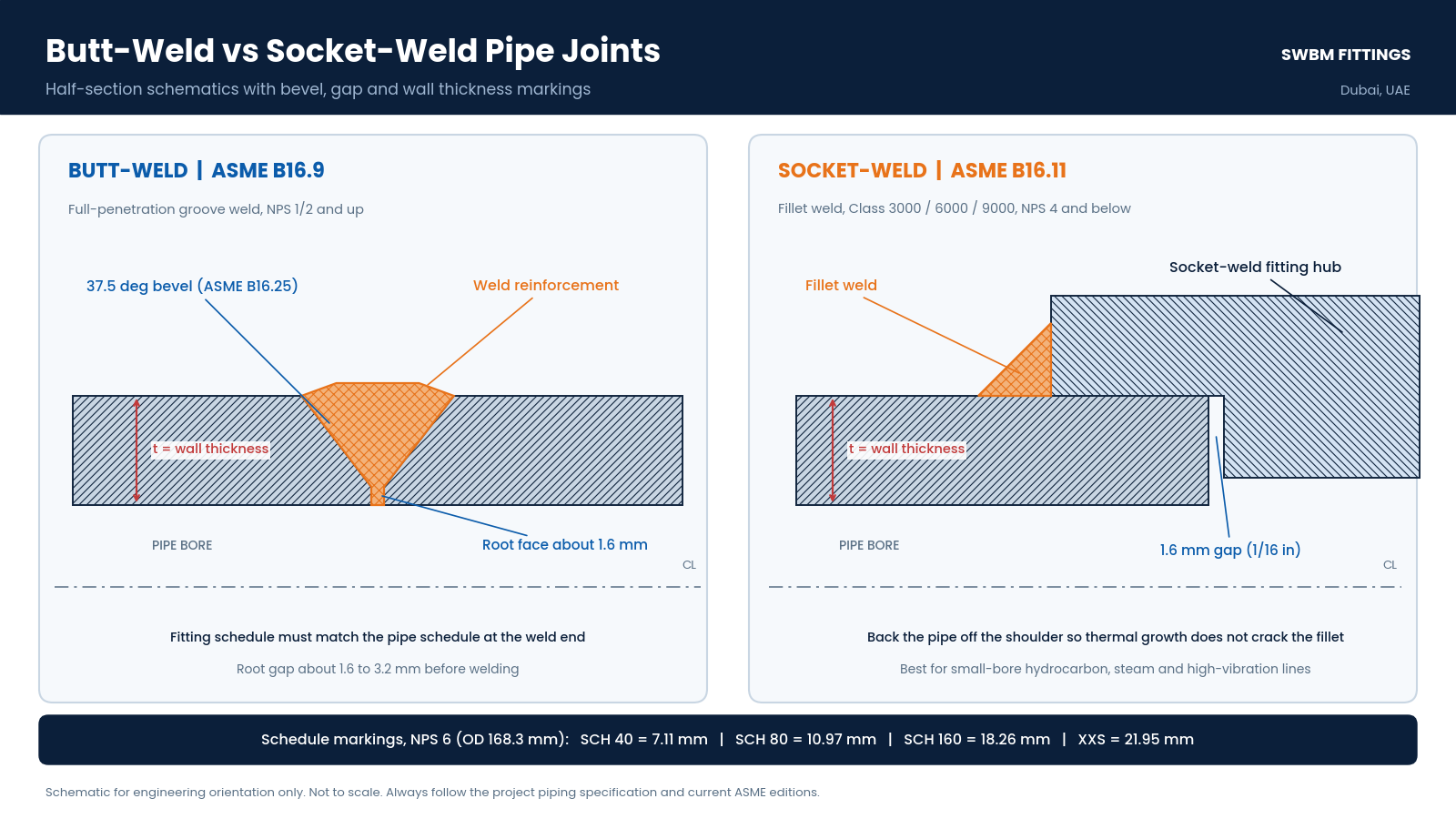
ASME B16.9 covers factory-made wrought butt-welding fittings: elbows, tees, reducers and caps that are welded directly to the pipe end. Their continuous weld joint gives the strongest, leak-resistant connection, which is why they dominate large-bore oil, gas, steam and process lines.
The range includes long and short radius 90° and 45° elbows, equal and reducing tees, concentric and eccentric reducers, and caps. A buyer comparing an ASME B16.9 fittings supplier across the GCC should check that the stocked schedules match the pipe on the line list.
SWBM Fittings holds both carbon steel and stainless steel pipe fittings Dubai projects specify, in butt-weld form, including SCH 10, SCH 40 and SCH 80 items. State the fitting schedule on every purchase line, because a SCH 80 fitting welded to SCH 40 pipe forces internal tapering and extra inspection.
What Are ASME B16.11 Forged Fittings?
ASME B16.11 covers forged steel threaded and socket-weld fittings for small-bore instrument, drain, vent and utility lines up to NPS 4. Threaded fittings carry Class 2000, 3000 and 6000 ratings, while socket-weld fittings carry Class 3000, 6000 and 9000 ratings.
Choose socket-weld for hydrocarbon, steam and high-vibration service because it avoids the leak paths of tapered threads. Leave a 1.6 mm gap at the socket bottom before welding so thermal expansion does not crack the fillet. Reserve NPT threaded joints for utility air, water and non-critical instrument lines.
The high pressure pipe fittings range at SWBM Fittings lists forged steel 2000, 3000 and 6000 PSI fittings and stainless steel 3000, 6000 and 10000 PSI fittings. Confirm class, end connection and thread type with your supplier before ordering.
Which Flange Type Fits Which Duty?
Weld neck flanges suit high-pressure, high-temperature and cyclic service because the tapered hub spreads stress into the pipe wall, while slip-on flanges suit lower-pressure utility lines. Blind flanges close line ends, threaded flanges avoid welding in non-critical lines, and socket-weld flanges serve small-bore high-pressure piping.
Under ASME B16.5 the pressure classes run from Class 150 to Class 2500 for NPS 1/2 to 24. A Group 1.1 carbon steel flange rated Class 150 holds about 19.6 bar at ambient temperature, while Class 300 holds about 51.1 bar and Class 600 about 102 bar. Ratings fall as temperature rises, so always check the temperature table.
Match each industrial flanges face type, such as raised face or ring-type joint, to the mating flange and gasket. The table below matches each connection type to its standard, class and best-fit industry, so your quotation request starts from the right specification.
| Connection type | Standard | Size range | Pressure class | Ideal application |
|---|---|---|---|---|
| Butt-weld elbow, tee, reducer, cap | ASME B16.9 | NPS 1/2 to 48 | Matches pipe schedule (SCH 10 to XXS) | Large-bore oil, gas, steam and process lines |
| Socket-weld fitting | ASME B16.11 | NPS 1/8 to 4 | Class 3000, 6000, 9000 | Small-bore hydrocarbon, steam and instrument lines |
| Threaded (NPT) fitting | ASME B16.11 | NPS 1/8 to 4 | Class 2000, 3000, 6000 | Utility air, water and non-critical lines |
| Weld neck flange | ASME B16.5 | NPS 1/2 to 24 | Class 150 to 2500 | High-pressure, high-temperature and cyclic service |
| Slip-on flange | ASME B16.5 | NPS 1/2 to 24 | Class 150 to 300 typical | Low-pressure utility and cooling water |
How Do You Select Carbon, Stainless or Duplex Steel for GCC Service?
Select material from the fluid, design temperature, chloride exposure and sour-service status, not from price. Carbon steel suits hydrocarbons, steam and utilities, austenitic stainless suits corrosive and hygienic service, and duplex or super duplex suits chloride-rich seawater and high-pressure sour environments.
Gulf conditions amplify risk. Coastal humidity, airborne chloride, high ambient temperatures and brackish process water attack passive films and coatings faster than inland environments do. Material choice therefore has to account for corrosion under insulation and chloride pitting as well as pressure.
When Is Carbon Steel A234 WPB or A105 the Right Choice?
Carbon steel ASTM A234 WPB suits butt-weld fittings and ASTM A105 suits forged fittings and flanges in hydrocarbon, steam, fire water and general utility lines. Both grades offer high strength at low cost across moderate temperatures, but they need coating or cathodic protection against external corrosion in humid coastal sites.
Carbon steel loses toughness in cold service. Below about -29 °C, specify impact-tested low-temperature grades such as ASTM A420 WPL6. In sour service, NACE MR0175 and ISO 15156 limit carbon steel hardness to 22 HRC, so request hardness results with the MTC.
Corrosion under insulation (CUI) is the typical Gulf failure vector for carbon steel steam and chilled-water lines. Wet insulation traps chlorides against the metal surface, and the damage stays hidden until a leak appears. Specify coating systems and inspect insulation seals during every shutdown.
Why Do Coastal Dubai Projects Need SS 304/304L or 316/316L?
Stainless steel 316L resists chloride pitting better than 304L because it contains 2 to 3 percent molybdenum, so it is the default for coastal MEP, marine and desalination-adjacent lines in Dubai. Grade 304L suits freshwater, food-grade and mildly corrosive service where chloride levels stay low.
The low-carbon L-grades cap carbon at 0.03 percent, which prevents chromium carbide formation in weld heat-affected zones. For fittings, ASTM A403 WP304L and WP316L are the standard designations. Above roughly 60 °C in stagnant seawater, chloride stress corrosion cracking becomes a risk, and engineers move to duplex.
When Are Duplex, Super Duplex and Alloy Steel Fittings Required?
Duplex and super duplex stainless steels are required when chloride content, pressure or sour-gas exposure exceeds what austenitic grades tolerate. Duplex UNS S31803 or S32205 more than doubles the yield strength of 316L, while super duplex UNS S32750 delivers a pitting resistance number (PREN) above 40 for seawater injection and subsea manifolds.
Alloy steel grades ASTM A234 WP11 and WP22 serve high-temperature steam and refinery heater lines, where chromium-molybdenum content resists creep. These grades need controlled preheat and post-weld heat treatment, so confirm welding procedure qualification before ordering.
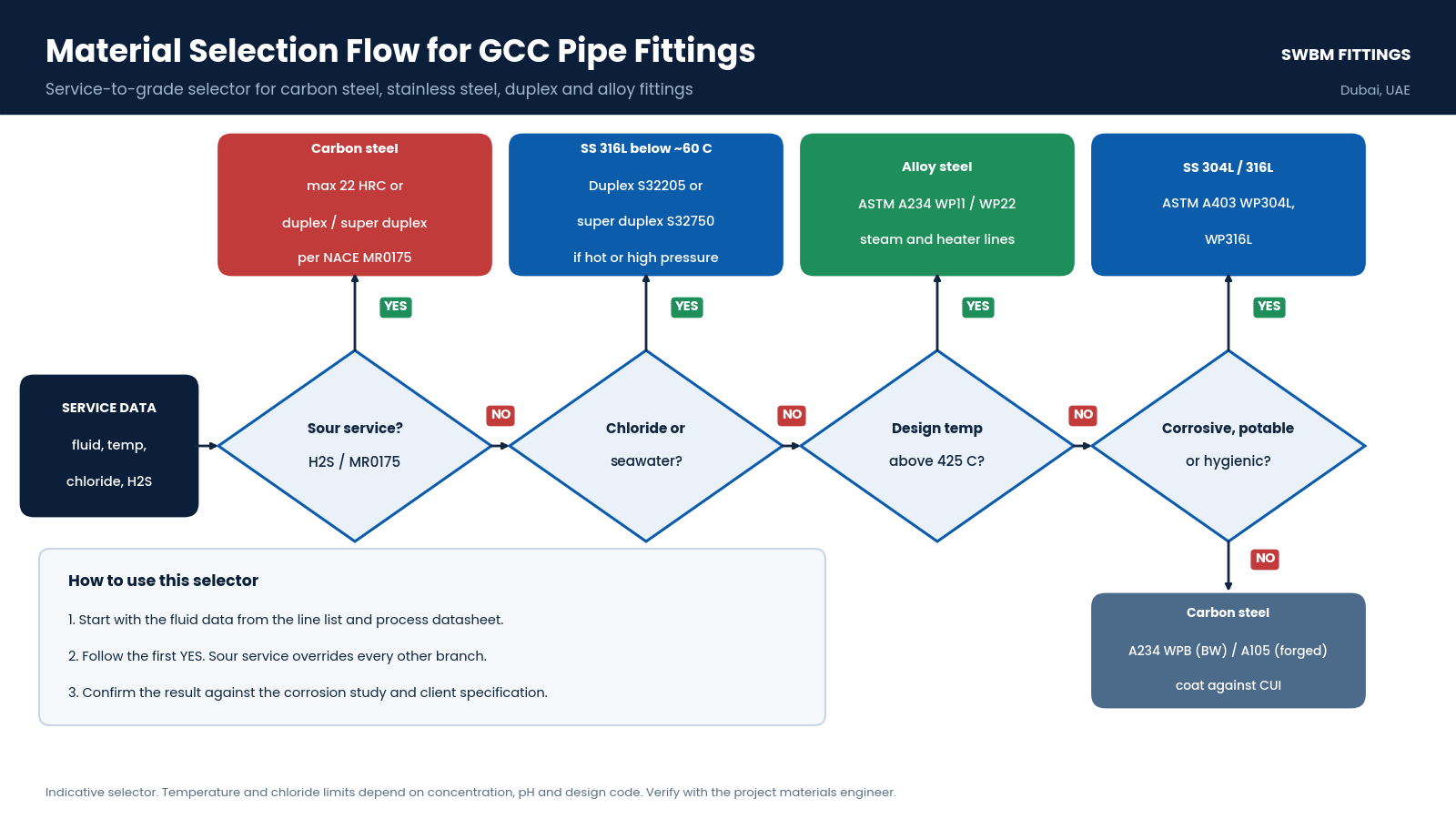
The table below compares the three material families on the attributes that drive purchase decisions. Use it with the flowchart above to shortlist a grade before you request quotes.
| Attribute | Carbon steel | Austenitic stainless | Duplex and super duplex |
|---|---|---|---|
| Fitting specification | ASTM A234 WPB (butt-weld), A105 (forged) | ASTM A403 WP304L, WP316L; A182 F304L, F316L | ASTM A815 S31803, S32205, S32750; A182 F51, F53 |
| Typical temperature range | About -29 °C to 425 °C | Cryogenic to about 550 °C | About -50 °C to 300 °C |
| Chloride resistance | Low | Moderate (316L above 304L) | High to very high |
| Typical GCC use | Hydrocarbon, steam, fire water, chilled water | Chemicals, potable water, coastal MEP | Seawater, sour gas, subsea and high-pressure chemical |
| Key checks | CUI protection, coating, hardness for sour service | Chloride SCC above about 60 °C, passivation | PMI, ferrite balance, NACE hardness limits |
Which Fitting Grades Suit Each GCC Sector?
Oil, gas, petrochemical and power plants lean on A234 WPB, A105 and alloy grades, while marine, water treatment and coastal MEP projects lean on 316L and duplex. Matching grade to sector narrows your RFQ before you contact any supplier and cuts clarification rounds.
Oil, gas, petrochemical and power
- Process and pipeline runs: A234 WPB butt-weld fittings with A105 weld neck flanges.
- Small-bore instrument lines: A105 socket-weld fittings, Class 3000 or 6000.
- Steam and heater lines: A234 WP11 or WP22 alloy fittings.
Marine, water treatment and MEP
- Seawater intake and brine lines: duplex or super duplex.
- Potable and process water: SS 304L or 316L butt-weld fittings and flanges.
- Chilled and fire water: A234 WPB with a protective coating system.
Need a quick material check? Brief the SWBM Fittings team with a grade, class and schedule. Send your line list and ask the team to check it against available stock.
What Do SCH 40, 80, 160 and XXS Mean for Pressure Safety?
Pipe schedule numbers describe wall thickness for a given nominal size, and a heavier schedule contains higher pressure at the same diameter. For example, NPS 6 pipe measures 7.11 mm at SCH 40, 10.97 mm at SCH 80, 18.26 mm at SCH 160 and 21.95 mm at XXS under ASME B36.10M.
Stainless pipe follows ASME B36.19M, which adds an S suffix such as SCH 10S and SCH 40S. For NPS 6, SCH 10S is only 3.40 mm, so never treat a thin-wall stainless schedule as equal to a carbon steel schedule.
| Schedule (NPS 6, OD 168.3 mm) | Wall thickness (mm) | Inside diameter (mm) | Typical use |
|---|---|---|---|
| SCH 10S | 3.40 | 161.5 | Low-pressure stainless process and utility lines |
| SCH 40 | 7.11 | 154.1 | General process, steam and utility lines |
| SCH 80 | 10.97 | 146.4 | Higher-pressure hydrocarbon and steam lines |
| SCH 160 | 18.26 | 131.8 | Very high-pressure service |
| SCH XXS | 21.95 | 124.4 | Extreme pressure and severe duty |
Schedule alone does not set thickness. ASME B31.3 calculates minimum wall from design pressure, allowable stress, weld joint quality and corrosion allowance, then allows for the 12.5 percent mill undertolerance. The hydrotest at 1.5 times design pressure proves the margin before service.
How Do ASME, DIN, EN and BS Standards Align?
ASME B16.9, B16.11 and B16.5 dominate Gulf oil, gas and petrochemical specifications, while EN 10253 and EN 1092-1 apply on European-designed MEP and water projects. Legacy DIN and BS drawings still appear on older plants, so engineers must map each dimension and rating to a current equivalent before ordering.
Flange ratings use different languages. ASME uses Class 150 to 2500, while EN 1092-1 uses PN ratings such as PN 16 and PN 40. Bolt circles and hole counts differ, so flanges from different standards do not mate. Ask your supplier to quote against the specified standard and edition.
What Compliance Checks Should a Pipe Fittings Supplier UAE Dubai Meet Before Shipping?
Gulf projects require documented traceability, dimensional conformance and, for critical service, positive material identification and non-destructive testing before fittings ship to site. Client approved vendor lists, third-party inspection and the project piping specification define the exact scope, so confirm them before you issue a purchase order.
Every fitting should carry the markings required by MSS SP-25: manufacturer, size, schedule or class, material grade and heat number. The heat number links the fitting to its Material Test Certificate, so a missing or illegible mark breaks the traceability chain. A stockist should show these marks before dispatch.
What Does an EN 10204 3.1 MTC Prove?
An EN 10204 3.1 Material Test Certificate confirms that the manufacturer’s authorised representative, independent of the production department, tested the delivered lot and recorded chemical composition, mechanical properties and heat number. It proves the fitting matches its specification, but only if the heat number on the certificate matches the stamp on the fitting.
How Do You Verify a Fitting Lot in Five Checks?
Verify each lot in five checks: standard and dimensions, material and heat traceability, schedule and class match, service compliance, and documentation. Run the checks at receiving inspection and record the result against the purchase order so any rejection traces to one lot.
- Standard and dimensions: confirm ASME B16.9 or B16.11 marking, then measure centre-to-end, 37.5° bevel and wall thickness.
- Material and heat traceability: match every heat number to the MTC and confirm the grade, for example WPB or WP316L.
- Schedule and class match: compare schedule against the pipe and class against the line list.
- Service compliance: run PMI on alloy and stainless items, and collect hardness reports and NDT results where specified.
- Documentation: file certificates, packing lists and marking photographs with the purchase order.
How Should You Write a Fitting RFQ Line?
Write each RFQ line as a complete specification: product, angle or type, connection, size, schedule, standard, material grade and certificate. A complete line removes assumptions, so every supplier quotes the same item and your procurement team can compare prices fairly.
ELBOW 90 DEG LR, BW, NPS 6, SCH 40S, ASME B16.9, ASTM A403 WP316L-S, MTC EN 10204 3.1
TEE EQUAL, BW, NPS 8, SCH 40, ASME B16.9, ASTM A234 WPB, MTC EN 10204 3.1
ELBOW 90 DEG, SW, NPS 1, CLASS 6000, ASME B16.11, ASTM A105, MTC EN 10204 3.1
FLANGE WN RF, NPS 6, CLASS 300, SCH 80 BORE, ASME B16.5, ASTM A105, MTC EN 10204 3.1
Why Choose a Direct-Stocking Pipe Fittings Supplier UAE Dubai Teams Rely On?
A direct-stocking supplier in the UAE shortens lead time against import-only sourcing, keeps heat-number lots together and lets engineers inspect material before dispatch. Local stock also removes ocean-freight and customs exposure from shutdown schedules, which cost far more per day than the fittings themselves.
Which Procurement Failures Cause Site Downtime?
Four procurement failures commonly cause fitting-related site delays: unmatched heat numbers, wrong schedule at the weld end, missing certificates and partial deliveries from multiple sources. Each failure is preventable by specifying the full RFQ line and buying from a supplier that holds stock and documents under one roof.
- Unmatched heat numbers: stamps and MTCs disagree, so the lot is quarantined.
- Wrong schedule: the fitting cannot be welded without tapering or rework.
- Missing certificates: inspectors block installation until documents arrive.
- Split deliveries: mixed heats and late items stall the weld sequence.
SWBM Fittings, a supplier contractors can audit, lists 10,000+ stock line items across a 20,000 sq ft warehouse. It also offers machining and fabrication, coating and surface treatment, and logistics and supply chain services for Dubai, Abu Dhabi, the Northern Emirates and other GCC markets. Confirm availability and certificates before you commit to a shutdown date.
Final Recommendations for Choosing a Pipe Fittings Supplier UAE Dubai
The strongest supplier engineers can depend on stocks the full range, documents every lot and understands service conditions. Use the five takeaways below to audit every purchase line.
- Write the full RFQ line: product, size, schedule, standard, grade and certificate.
- Choose the grade from chloride, temperature and sour-service exposure.
- Match fitting schedule to pipe and flange class to pressure and temperature.
- Verify heat numbers against EN 10204 3.1 certificates at receiving.
- Buy from a stockist that holds material and documents locally.
Ready to verify your next fitting package? Send your line list, grades and schedules to SWBM Fittings for a stock check and quotation, and ask for EN 10204 3.1 certificates with every lot.
Frequently Asked Questions About Pipe Fittings in the UAE
What is the difference between ASME B16.9 and ASME B16.11 fittings?
ASME B16.9 covers butt-weld fittings for pipe from NPS 1/2 upward, welded end to end and matched to the pipe schedule. ASME B16.11 covers forged threaded and socket-weld fittings up to NPS 4, rated by pressure class such as 3000 or 6000. Use B16.9 for large-bore lines and B16.11 for small-bore lines.
Which stainless steel grade is best for coastal Dubai installations?
SS 316L is the standard choice for coastal Dubai installations because its molybdenum content resists chloride pitting better than 304L. For warm seawater, high pressure or sour service, duplex or super duplex grades give a safer margin, so confirm the grade against the fluid and temperature before ordering.
What documents should a pipe fittings supplier in Dubai provide?
A supplier should provide an EN 10204 3.1 Material Test Certificate that matches the heat number stamped on each fitting, plus a packing list and dimensional conformance to ASME B16.9, B16.11 or B16.5. For critical service, also request PMI results, hardness reports for NACE MR0175 service and EN 10204 3.2 third-party inspection.