
An impulse line on a Gulf gas compression skid rarely fails in the first week. It fails after months of vibration, heat cycling and salt-laden air, usually at a tube joint nobody questioned during procurement.
Choosing stainless steel pipe fittings suppliers UAE operators can rely on starts with understanding why that joint fails. This guide covers double ferrule mechanics, threaded pressure classes, SS316L and duplex metallurgy, sour service rules and the certification that proves each claim.
It is written for instrument engineers, procurement heads and plant operators in refineries, offshore platforms, petrochemical plants and desalination facilities across the UAE and GCC.
Table of Contents
- How Does a Double Ferrule Fitting Seal at High Pressure?
- Which Is Better, Double Ferrule, Single Ferrule or Threaded NPT Connections?
- How High Can Threaded Instrumentation Fittings Be Rated?
- Where Do Instrument Tube Fittings Sit in Plant Hook-Ups?
- Why Is SS316L the Default for Gulf Instrumentation Fittings?
- How Does NACE MR0175 / ISO 15156 Affect Sour Service Fittings?
- Which Standards Govern Rating, Tubing and Testing?
- What Should You Check Before Choosing Stainless Steel Pipe Fittings Suppliers in UAE?
- Why Does Local Stock in Dubai Reduce Project Delay?
- Final Specification Rules for UAE Instrumentation Fittings
- Frequently Asked Questions
How Does a Double Ferrule Fitting Seal at High Pressure?
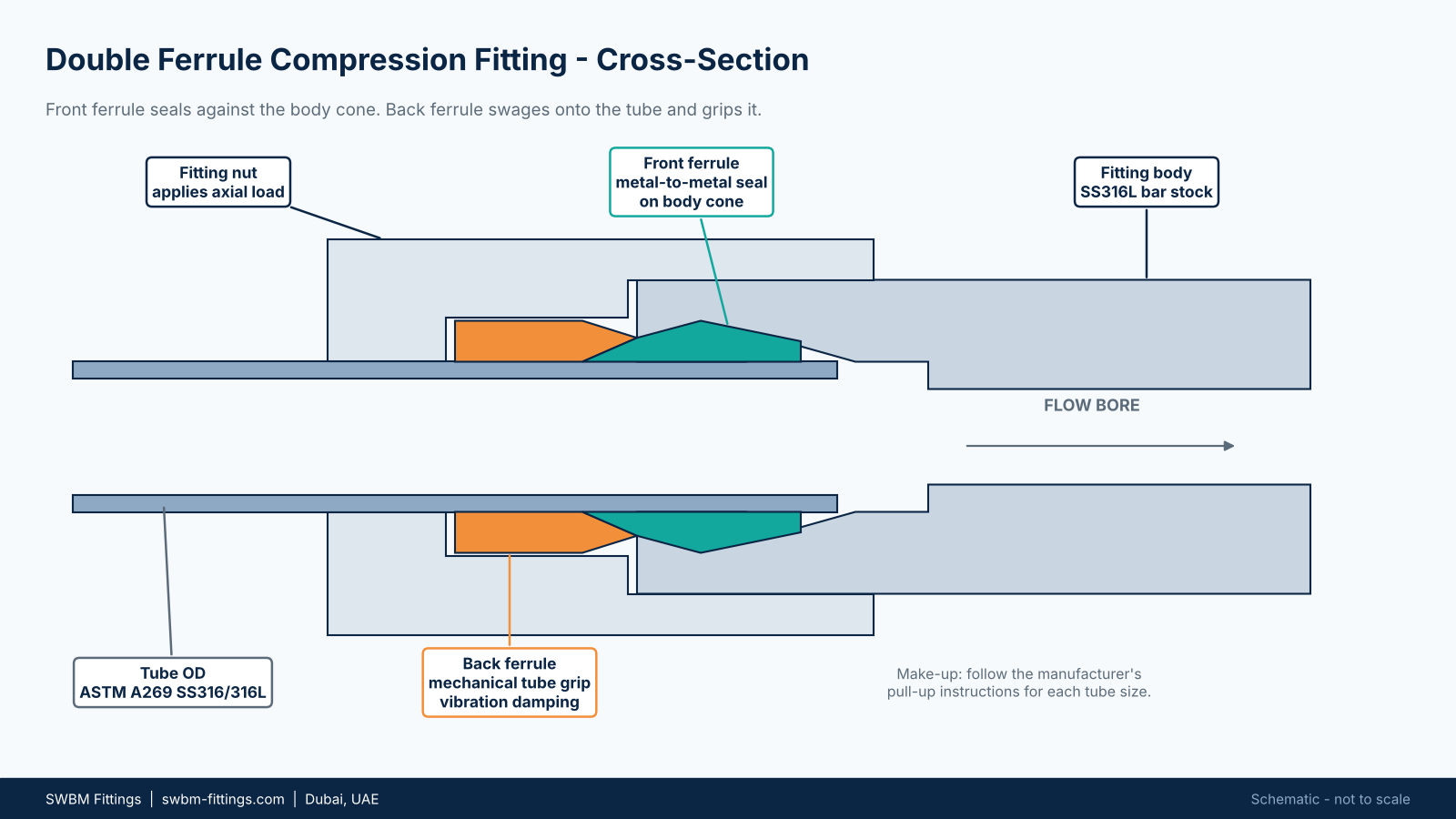
A double ferrule compression fitting seals through two separate metal components that work in sequence. The front ferrule forms a metal-to-metal seal against the body cone, while the back ferrule drives into the tube wall to create a mechanical grip. Tightening the nut loads both, so sealing and holding work independently.
On pull-up, the nut pushes the back ferrule forward, and the back ferrule pushes the front ferrule into the body cone. The back ferrule bites into the tube outside diameter, while the front ferrule seats against the cone and forms the pressure seal. Both parts must sit in the correct orientation.
That metal-to-metal seal is why plants buying double ferrule compression fittings UAE wide specify them for zero-leak impulse lines. There is no elastomer to extrude, age or swell in hydrocarbon service.
Reversed or mismatched ferrules are a leading cause of field leaks. Order a matched SS316 nut and ferrule set with each connector body, and never mix components between brands.
Why Does the Back Ferrule Control Vibration Fatigue?
The back ferrule isolates the sealing zone from tube vibration by gripping the tube behind the front ferrule. Cyclic bending stress then concentrates at the grip point rather than at the seal, which protects impulse lines near pumps, compressors and wind-exposed skids from fatigue cracking.
Failure in vibrating service follows predictable patterns:
- Unsupported tube runs that flex at the nut face and crack the tube
- Under-tightened nuts that allow ferrule slip under pulsation
- Over-tightened nuts that collapse the tube wall and restrict flow
- Tube harder than the ferrule, which prevents the back ferrule from biting
Clamp small-bore tubing at the spacing set by the project specification, commonly 0.6 to 1 m, and keep the tube annealed to the fitting manufacturer’s hardness limit.
Which Is Better, Double Ferrule, Single Ferrule or Threaded NPT Connections?
Double ferrule fittings give the best leak integrity and vibration tolerance for instrument tubing, while single ferrule designs suit light-duty, low-vibration lines. Threaded NPT joints suit direct process tappings and instrument ports, and most plants use all three, matched to pressure, vibration and how often the joint is disassembled.
| Attribute | Double ferrule compression | Single ferrule compression | Threaded NPT |
|---|---|---|---|
| Sealing method | Front ferrule, metal to metal on body cone | One ferrule seals and grips | Thread engagement plus sealant |
| Vibration tolerance | High, back ferrule damps | Moderate | Low to moderate |
| Leak integrity at high pressure | Excellent | Good | Fair, depends on make-up |
| Remake capability | Several remakes with care | Limited | Limited, thread wear |
| Best fit | Impulse, sampling and injection tubing | Light-duty air or utility tubing | Process tappings, instrument ports |
| Main risk | Wrong tube hardness or mixed brands | Tube slip under vibration | Sealant leak path, thread galling |
Threaded joints depend on thread deformation and sealant, so vibration can loosen them and PTFE shreds can foul analyser lines. Stainless threads also gall if assembled dry. Reserve NPT for process tappings and instrument ports, and use compression fittings for the tubing runs between them.
How High Can Threaded Instrumentation Fittings Be Rated?
Forged stainless steel threaded fittings are commonly supplied in 6,000 PSI and 10,000 PSI classes for instrument adapters, elbows, tees, crosses, unions and gauge snubbers. The working pressure depends on size, wall section, thread form and temperature derating, so confirm the rating from the manufacturer’s table and the material certificate.
SWBM supplies stainless steel 6000 PSI fittings for general instrument service, and 10,000 PSI classes where margins are tighter. For high pressure instrumentation fittings Dubai projects require, verify the rating against the exact size, wall and thread.
Common threaded components in instrumentation service:
- Instrument adapters convert between tube OD and NPT, BSPT or BSPP ports
- Elbows and tees route signal lines without bending stress on the tube
- Crosses serve multi-instrument manifolds in compact skids
- Union couplings allow instrument removal without disturbing pipework
- Gauge snubbers damp pulsation that would otherwise damage the Bourdon tube
How Do NPT, BSPT and BSPP Threads Differ?
NPT and BSPT are tapered threads that seal by thread engagement and sealant, while BSPP is a parallel thread that seals on a washer or bonded seal. NPT uses a 60-degree thread form and BSP uses 55 degrees, so mixing them damages threads and causes leaks.
- NPT (ASME B1.20.1): 60° tapered thread, sealed with PTFE tape or paste
- BSPT (ISO 7-1): 55° tapered thread, common on European and Asian equipment
- BSPP (ISO 228-1): 55° parallel thread, sealed on a washer or bonded seal face
Gulf plants often hold mixed North American and European equipment, so check every instrument port before ordering adapters.
Where Do Instrument Tube Fittings Sit in Plant Hook-Ups?
Instrument tube fittings connect process tappings to transmitters, gauges, analysers and injection points. They carry pressure signals through impulse tubing, deliver conditioned gas to chromatographs and feed chemicals through injection skids, and each application sets different demands on pressure rating, cleanliness, vibration tolerance and material grade.
- Impulse tubing and transmitter hook-ups carry pressure through the root valve, needle valve and tube joints, with lines sloped to drain or vent
- Gas chromatography sampling lines need small bore, minimal dead volume and clean SS316L surfaces, with no thread sealant near the analyser
- Chemical injection skids see plunger-pump pulsation, so use heavier-wall tube and double ferrule joints that tolerate fatigue
- Gauge and switch connections need snubbers and isolation valves so instruments can be serviced without depressurising the line
A consistent hook-up layout uses compression joints on every tube run and threads only at the tapping and instrument ports. Keeping that rule makes inspection and leak testing faster.
Specifying a new hook-up? Compare tube OD sizes, NPT port options and connector bodies across the high pressure instrumentation fittings Dubai range, then match each line to the PMTCD checklist later in this guide.
Why Is SS316L the Default for Gulf Instrumentation Fittings?
SS316L is the default because its 2-3% molybdenum content resists pitting and chloride attack better than 304, while its low carbon limit protects welded and heat-affected zones. It performs well in coastal UAE atmosphere, but warm seawater, hot brine and splash zones can exceed its limits.
Molybdenum strengthens the passive film that resists chloride pitting, and low carbon reduces chromium carbide precipitation during welding. For stainless steel 316 instrumentation fittings GCC projects specify, this balance of corrosion resistance, availability and cost is hard to beat.
Limits still apply. Above roughly 60 °C in chloride-bearing environments, austenitic grades can suffer chloride stress corrosion cracking, and sun-heated tubing in the UAE can reach that range. Pair fittings with certified stainless steel tube from the same heat-traceable chain.
When Should You Upgrade to Duplex 2205 or Super Duplex 2507?
Upgrade when chloride concentration, temperature or crevice conditions exceed what SS316L tolerates. Duplex 2205 (UNS S31803) suits offshore topsides and seawater-cooled service, while super duplex 2507 (UNS S32750) suits subsea installations, hot brine and desalination lines where pitting resistance equivalent numbers above 40 are required.
| Property | SS316 / 316L | Duplex 2205 | Super duplex 2507 |
|---|---|---|---|
| UNS number | S31600 / S31603 | S31803 / S32205 | S32750 |
| Molybdenum | 2–3% | 3.0–3.5% | 3.0–5.0% |
| Typical PREN | ~24 | ~35 | ~42 |
| Minimum yield strength | 170 MPa | 450 MPa | 550 MPa |
| Typical service | Onshore, coastal air, gas sampling | Offshore topsides, seawater cooling | Subsea, hot brine, desalination |
| Main limit | Chloride SCC above ~60 °C | Toughness loss above ~300 °C | Higher cost, longer lead time |
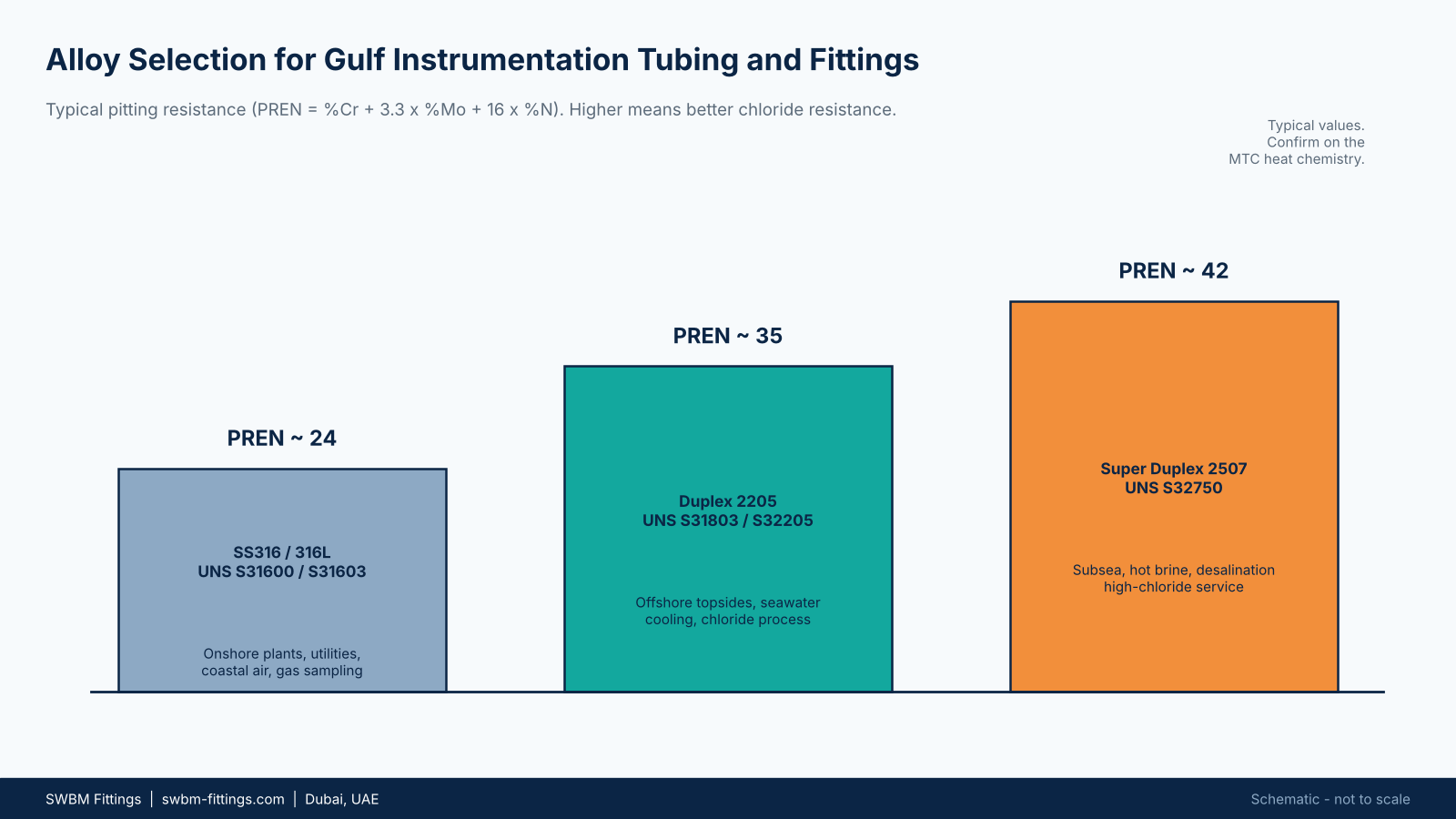
Duplex grades also carry more than double the yield strength of 316L, which allows lighter tube walls at the same pressure. They lose toughness above about 300 °C, so avoid them in hot service. The International Molybdenum Association publishes alloy guidance for grade comparison.
How Does NACE MR0175 / ISO 15156 Affect Sour Service Fittings?
NACE MR0175 / ISO 15156 limits which materials, hardness levels and heat treatments are acceptable where hydrogen sulfide is present. It exists to prevent sulfide stress cracking, a hydrogen-related failure that can fracture a fitting without visible warning, so every fitting and tube in sour service needs matching material evidence.
NACE International is now part of AMPP, and the standard is published jointly with ISO. Acceptance depends on H₂S partial pressure, temperature, chloride content and pH, so one grade can pass in one stream and fail in another.
Before releasing fittings for sour service, check:
- The grade and condition appear in the ISO 15156-3 tables for your stated environment
- Hardness stays within the limit, commonly cited as 22 HRC maximum for solution-annealed austenitic stainless steel
- Cold working during tube forming or machining has not pushed hardness above that limit
- Ferrules, nuts and bodies are reviewed together, not the body alone
- The MTC states hardness and heat treatment condition
When comparing stainless steel pipe fittings suppliers UAE operators should ask for written sour service statements tied to heat numbers, not generic catalogue claims.
Which Standards Govern Rating, Tubing and Testing?
ASME B31.3 governs process piping design and leak testing, ASTM A269 defines seamless and welded austenitic stainless tubing, and ISO 19879 defines test methods for metallic tube connections. Together they set the pressure design basis, the tube quality that fittings must grip, and the proof that a connection performs.
ASME B31.3 also sets fluid service categories, including Category M for toxic fluids, which tightens leak testing expectations. ASTM A269 tubing must be annealed and dimensionally consistent for a ferrule to bite correctly. ISO 19879 is a fluid-power test method reference, so treat it as evidence of connection performance rather than a plant specification.
What Does a 4:1 Burst Safety Factor Mean?
A 4:1 burst safety factor means the fitting and tubing assembly must withstand at least four times its rated working pressure before bursting. A 6,000 PSI working rating therefore implies a burst capability of at least 24,000 PSI, a margin that covers pressure surges, material variation and long-term fatigue.
Ratings are quoted at ambient temperature and fall as temperature rises, which matters for sun-heated lines. The factor also applies only to a correctly made-up connection in tube of the specified wall and hardness.
Which Leak Test Applies, Hydrostatic, Nitrogen or Helium?
Hydrostatic testing proves strength at 1.5 times design pressure, pneumatic nitrogen testing checks tightness where water is unacceptable, and helium leak detection finds the smallest leaks in toxic or volatile hydrocarbon service. Match the method to the media, the consequence of a leak and the applicable ASME B31.3 fluid service category.
A defensible acceptance sequence for instrumentation fitting lots:
- Match MTC EN 10204 3.1 heat numbers to fitting markings and complete PMI on a sample
- Inspect dimensions, thread form and surface finish
- Run a hydrostatic test at 1.5 times design pressure where water is acceptable
- Run a pneumatic nitrogen test at 1.1 times design pressure where moisture is unacceptable, behind a safety exclusion zone
- Apply helium leak detection for toxic or volatile hydrocarbon media
- Dry, cap, mark and dispatch with the certificate pack
Nitrogen and helium tests carry stored-energy hazards, so only trained crews should run them. For high-consequence lines, specify helium detection in the purchase order rather than discovering leaks at commissioning.
What Should You Check Before Choosing Stainless Steel Pipe Fittings Suppliers in UAE?
Check material certification, traceability, stock depth, pressure rating evidence and technical support before you place an order. A reliable supplier issues MTC EN 10204 3.1 certificates linked to heat numbers, stocks the sizes you need locally and answers specification questions with data rather than catalogue claims.
Use the PMTCD checklist, a five-point framework for releasing instrumentation fittings to a line:
| Check | Question to answer | Evidence required |
|---|---|---|
| P, Pressure | What are working, surge and test pressures, and does the 4:1 burst margin hold? | Rating table, test pressure calculation |
| M, Media | Is the fluid sour, toxic, chloride-bearing or analyser-grade clean? | Fluid service category, process data |
| T, Temperature | What are operating and sun-heated surface temperatures, and what is the derating? | Temperature-adjusted rating |
| C, Corrosion | Does the grade suit coastal air, splash zone, seawater or sour service? | Grade selection, ISO 15156 statement |
| D, Documentation | Can every fitting be traced to a heat number? | MTC EN 10204 3.1, PMI and test records |
Any line that fails one check should not receive fittings from stock until an engineer reviews the gap. This turns procurement from a catalogue exercise into a documented engineering decision. Reputable stainless steel pipe fittings suppliers UAE operators trust will support each check with data.
Why Does Local Stock in Dubai Reduce Project Delay?
Local stock removes the import lead time that stalls shutdowns and commissioning, because fittings held in Dubai can be inspected and verified within days. Certificates are already on file, which protects turnaround schedules and removes the temptation to accept uncertified substitutes under time pressure.
An MTC to EN 10204 3.1 is issued by the manufacturer and validated by an authorised representative independent of the production department. It links each fitting to a heat number, which makes later audits and failure investigations possible.
Sunel Wala Building Materials (SWBM) has served oil and gas, marine and construction industries across the Middle East and Africa for more than two decades. Its logistics and supply chain support helps teams plan fitting deliveries against shutdown windows.
A strong instrument tube fittings supplier Dubai buyers can use delivers:
- Stocked sizes in common tube ODs and NPT ports
- Certificates that match the markings on the delivered lot
- Technical answers on rating, compatibility and sour service
- Fast quotation for urgent shutdown spares
Final Specification Rules for UAE Instrumentation Fittings
Reliable instrumentation starts at its smallest joint. Buyers who treat tube fittings as engineered components, not commodities, prevent the leaks, fatigue cracks and certificate disputes that delay start-ups. These rules summarise the guide for any stainless steel pipe fittings suppliers UAE evaluation.
- Use double ferrule compression fittings on tube runs, and threads only at ports
- Default to SS316L, and move to duplex 2205 or super duplex 2507 where chlorides or temperature demand it
- Confirm sour service compliance with ISO 15156 before release
- Hold a 4:1 burst margin, and select hydrostatic, nitrogen or helium testing by media
- Release fittings only with MTC EN 10204 3.1 traceability
Need a verified fitting list for your next shutdown or new build? Send your tube OD, wall thickness, media and pressure to the SWBM engineering team through the contact page for a technical quote. SWBM is a stocked instrument tube fittings supplier Dubai plants can contact for urgent and planned demand.
Frequently Asked Questions
What is the best material for instrumentation fittings in UAE coastal plants?
SS316L is the best starting material for most UAE coastal instrumentation fittings because molybdenum gives it strong pitting resistance in humid, chloride-laden air. Move to duplex 2205 or super duplex 2507 when fittings sit in splash zones, seawater service or hot brine, where 316L can pit or crack.
Can I mix tube and fittings from different manufacturers?
Mixing tube and fittings from different manufacturers is not recommended because ferrule geometry, hardness and tolerances differ between designs. A mismatch can cause leaks or tube slip at pressure, so use fittings from one manufacturer with annealed ASTM A269 tubing that meets that manufacturer’s hardness and wall thickness limits.
What documents should come with high-pressure instrumentation fittings?
Request an MTC to EN 10204 3.1 that lists the heat number, chemistry and mechanical properties, plus the pressure rating table, PMI or test records where specified, and NACE MR0175 / ISO 15156 compliance statements for sour service. Check that markings on each fitting match the certificate heat number.